- FOUNDATION
- |
- IPPE
- |
- PPFC
- |
- CONTACT
News Release
- Media Center Home /
- News Release View


For Immediate Release
U.S. Poultry & Egg Association
Tucker, Ga. - March 5, 2026
- Contact:
- Hannah Keck, 678.514.1979, hkeck@uspoultry.org, (USPOULTRY)
Researchers Evaluate Utilizing Carbonized Feathers in Visible Light-Responsive Photocatalytic Reactors for Poultry Odor Control
USPOULTRY and the USPOULTRY Foundation announce a newly finalized research project which uses feather-derived activated carbon and visible-light photocatalysis to reduce ammonia and odors in commercial poultry houses. Tested in a full-scale broiler facility, the system achieved consistent ammonia reductions under commercial conditions. This innovative approach, led by a team of researchers from Georgia Southern University, supports improved bird welfare, worker safety, environmental sustainability and circular use of poultry byproducts. The research is part of the Association’s comprehensive research program encompassing all phases of poultry and egg production and processing and is made possible in part through proceeds from the International Poultry Expo, part of the International Production & Processing Expo.
Project #F117: Utilizing Carbonized Feathers in Visible Light-Responsive Photocatalytic Reactors for Poultry Odor Control
(Dr. Mohammadamin Ezazi, Department of Mechanical Engineering, Georgia Southern University, Statesboro, Ga.)
The research project, led by Dr. Ezazi and researchers at Georgia Southern University, developed and validated a visible-light-responsive photocatalytic reactor for poultry odor control. Using activated carbon, including a value-added material produced from carbonized chicken feathers paired with a visible-light-active silver phosphate photocatalyst, the system effectively reduced ammonia while supporting sustainable use of poultry processing byproducts. Results demonstrated that combining adsorption with visible-light-driven photocatalysis offers an effective, longer-lasting ammonia control strategy that can improve air quality, bird welfare and worker safety, while reducing odors, maintenance costs, regulatory risks and reliance on chemical treatments. Overall, the project confirms the technical feasibility and industry applicability of this approach and establishes a strong foundation for future scale-up and implementation in poultry facilities.
The research summary can be found on the USPOULTRY website. Information on other Association research may also be obtained by visiting the USPOULTRY website.
###
More Recent News
June 11, 2026
USPOULTRY Poultry Processor Workshop Highlights Food Safety Innovations, Operational Excellence and Workforce Development
Poultry industry professionals recently gathered at the 2026 USPOULTRY Poultry Processor Workshop in Greenville, S.C., to explore the latest advancements in food safety, processing technolo...

June 10, 2026
USPOULTRY Foundation Accepting Applications for Industry Education Recruitment Funding Program
The USPOULTRY Foundation is accepting applications for its Industry Education Recruitment Funding Program, which supports colleges and universities working to attract and develop the next ge...
May 26, 2026
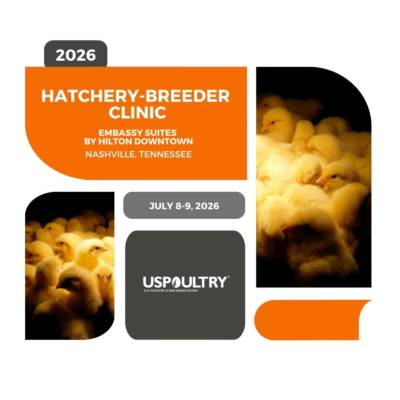
USPOULTRY to Host 2026 Hatchery-Breeder Clinic Focused on Innovation, Operational Excellence and Flock Performance
USPOULTRY will host its 2026 Hatchery-Breeder Clinic from July 8-9 in Nashville, Tenn. The annual clinic will bring together hatchery and breeder managers and other industry professionals to...

Contact Information
1530 Cooledge Road
Tucker, GA 30084-7303
Tel: 770.493.9401
Fax: 770.493.9257
General Info
Events & Meetings
People & Groups
- Affiliated States
- Air Cargo Committee
- Hen Council
- Industry Partners
- Poultry Protein & Fat Council
- USPOULTRY Foundation